Khanyar · Srinagar · Kashmir
Roza Bal:
The Tomb of Jesus
TJResearch.net presents the case that the ancient grave within Roza Bal belongs to Jesus—known in the Kashmir tradition as Yuz Asaf—who survived the crucifixion, continued east, and completed his life among the people of Kashmir.
Featured response
Death does not settle the question of return
Jesus: Dead or Alive? argues that Jesus survived the crucifixion, lived on, and eventually died—and concludes that he therefore cannot return. The new TJResearch.net response isolates the missing question: what changes if return is understood through reincarnation?
The crucifixion attempt did not end his life.
He continued east and eventually died of old age.
The original body and earthly lifetime came to an end.
That conclusion does not address reincarnation.
“If reincarnation is possible, death and a later return need not contradict each other. The question becomes what returns, and what evidence would establish that continuity.”
The response treats reincarnation as the possibility the earlier essay did not examine. It distinguishes that argument from proof of reincarnation, Christian resurrection, and simple continuation of Jesus’s mission.
The central case
Why the grave demands a closer reading
The modern identity assigned to the shrine does not resolve the older physical and documentary questions. The case rests on the grave beneath the later building, the traditions attached to Yuz Asaf, and evidence that does not fit an ordinary Islamic burial.
- Yuz Asaf, the foreign prophet
Kashmir traditions describe the person buried at Roza Bal as a prophet who came from the west. The documentary records interpretations of the name as “Jesus the Gatherer” or a leader of the healed.
- The inner grave runs east–west
The documentary reports that the actual grave beneath the visible structure lies on an east–west axis—an orientation its participants associate with an Israelite burial rather than the local qibla-oriented Muslim convention.
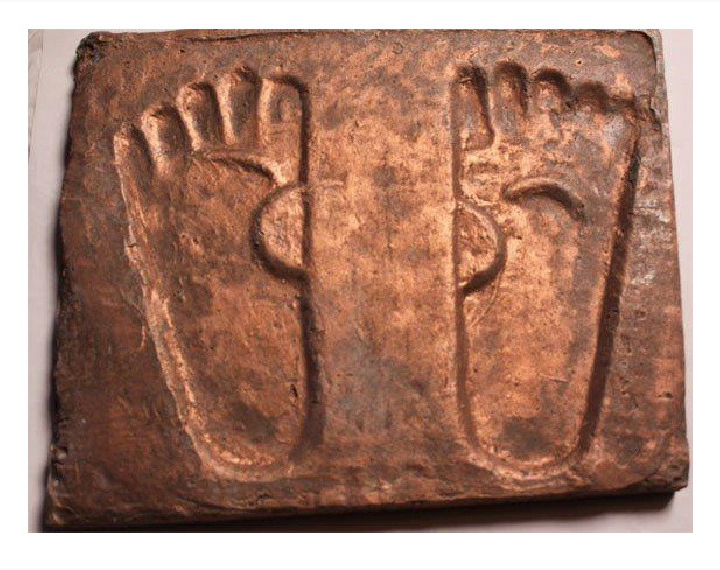
- Feet marked by crucifixion
A carved pair of feet long associated with the shrine bears wound-like markings. Researchers interpret their placement as a deliberate memory of crucifixion.
- The first-century inscription tradition
The film describes a now-destroyed inscription at the Temple of Solomon that identified Yuz Asaf as a prophet of the children of Israel and dated the tradition to 54 CE.
- A structure older than its later use
The documentary distinguishes the ancient grave and enclosure from later religious custody, arguing that the shrine’s present appearance should not be confused with the origin of the burial.
- A testable physical question
Accounts in the film describe an underground chamber and the possibility of surviving remains. Proposed DNA work did not proceed, leaving a physical question that could—in principle—be investigated.
The site in photographs
Look past the building
The modern shrine, its visible interior structures, and the older burial described beneath are not the same thing. These photographs document what a visitor can see today while keeping those historical layers distinct.
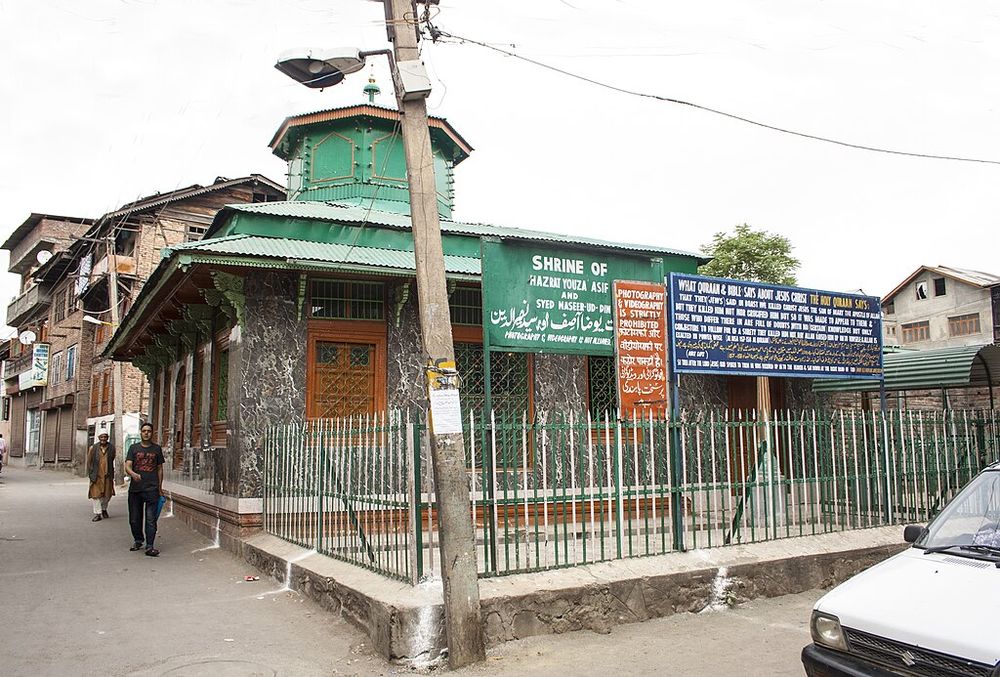
 The street façadeModern custodianship is visible on the building; it does not settle the identity of the older burial.
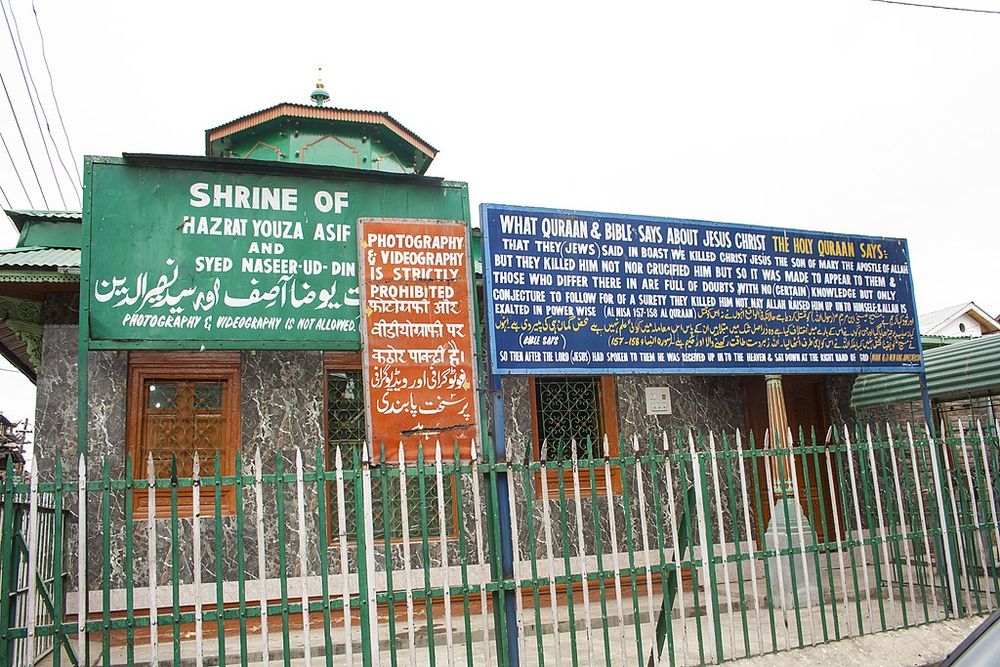
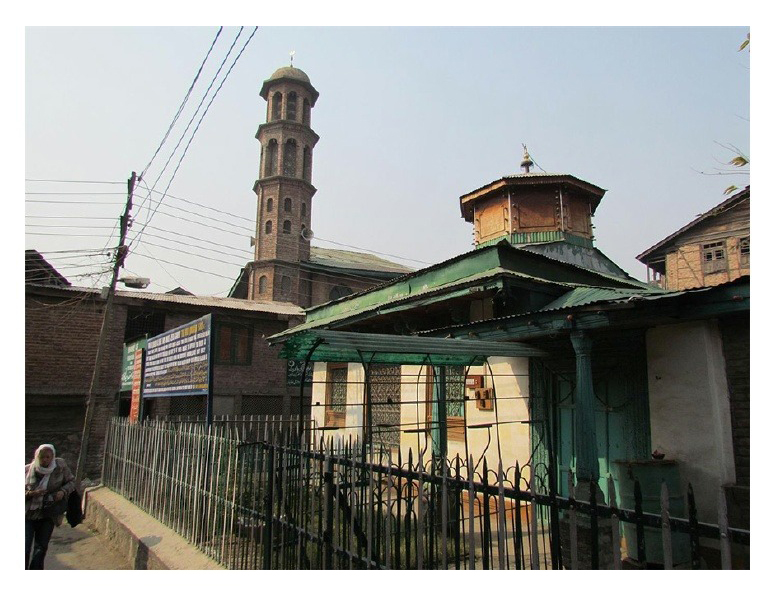 A place in contextThe shrine sits within the close streets of Khanyar, Srinagar.
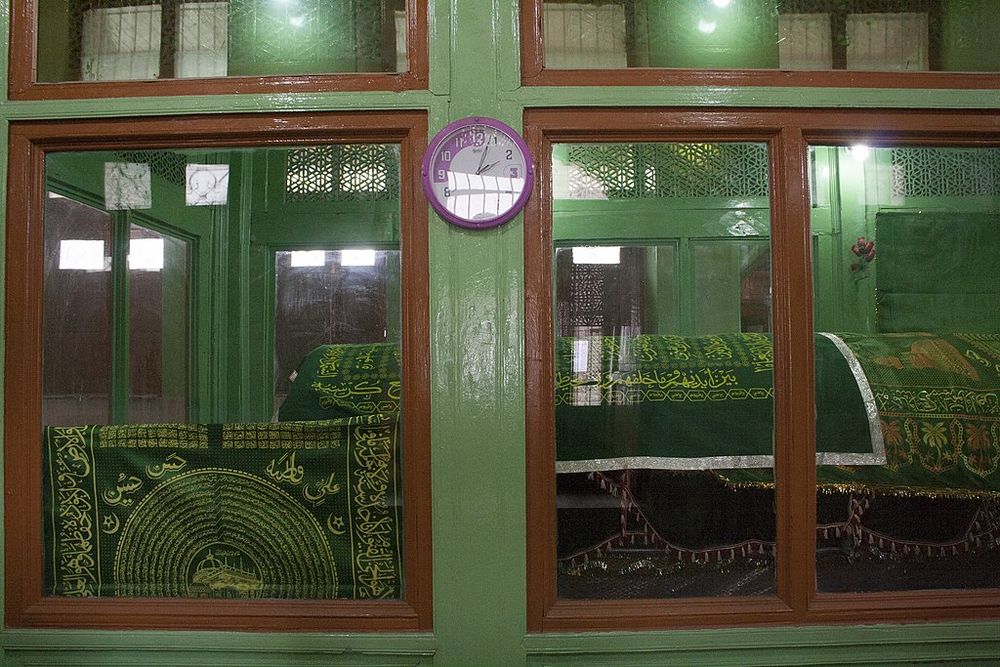 The interior enclosureThe visible surface structures are part of the shrine’s present-day presentation.
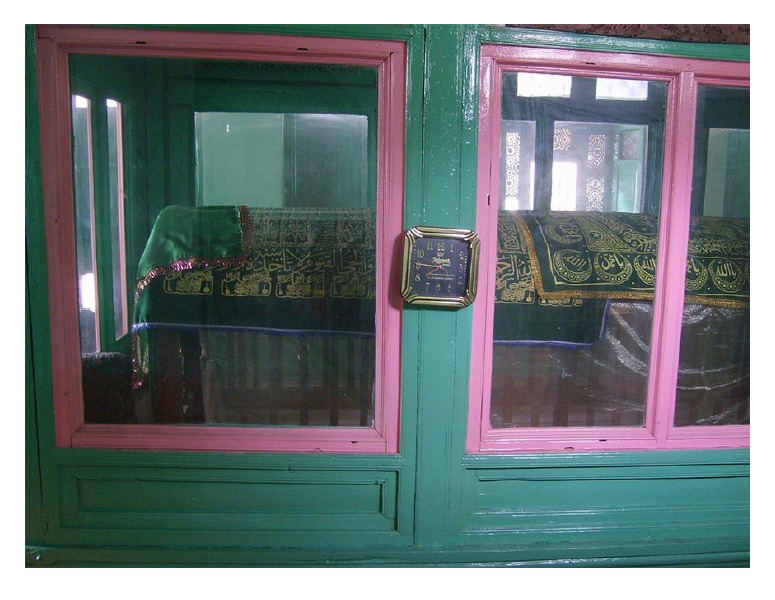 Detail behind glassA closer record of the interior visitors are permitted to see.
How to read these images: the present architecture records later use and custody. The historical question examined on this page concerns the orientation, identity, and traditions of the underlying grave.
A physical contradiction
The orientation matters
Islamic burial practice places the deceased on the right side facing the qibla. The long axis of the grave is therefore arranged in relation to Mecca. In Kashmir, that convention does not produce the reported east–west inner grave at Roza Bal.
The difference does not identify the occupant by itself. It does, however, challenge the claim that the underlying burial is simply that of an otherwise unknown local Muslim holy man.
| Roza Bal report | The older inner grave is described as east–west and associated with an Israelite/Jewish burial tradition. |
|---|---|
| Islamic practice | The body is placed on its right side facing the qibla; grave orientation follows that requirement. |
| Why it matters | The physical burial and the later religious use of the building may belong to different historical layers. |
Documentary testimony
The trail reaches Kashmir
Edward T. Martin’s documentary brings together researchers who disagree on important details, yet repeatedly return to the same location and identity question.
“Legends have it that Jesus lived a long time in northern India, in Kashmir, and that he has a tomb there. This tomb still exists today, but is well guarded; no one can get in.”
James Deardorff
“The direction of the tomb is in the Jewish direction, east-west facing. Which suggests that the inhabitant of that tomb would be a follower of Moses of Israelite origin.”
Arif Khan
“The tomb of Yuz Asaf is hundreds of years older than the beginning of Islam.”
Edward T. Martin
“I have no doubt. No doubt is in my heart that is Jesus in that tomb.”
Suzanne Olsson
The larger journey
Roza Bal is the final chapter
The tomb claim becomes intelligible only within the broader Jesus-in-India investigation: the missing years, the Himalayan Issa traditions, survival after crucifixion, and the eastward mission among dispersed Israelite communities.
Read the documentary highlights →Source transparency
Separate the evidence from its later framing
The former Tomb section is preserved intact for reference, including its photographs and source documents. It is no longer the editorial presentation of TJResearch.net.
Open the archived prior source package →Evidence note: The Islamic burial convention is documented by Egypt’s Dar al-Ifta: the deceased is placed on the right side facing the qibla. Claims specific to Roza Bal—including the inner grave’s direction, inscriptions, carved feet, and underground chamber—are attributed to participants in the supplied Jesus in India documentary and should be evaluated through the linked source index.